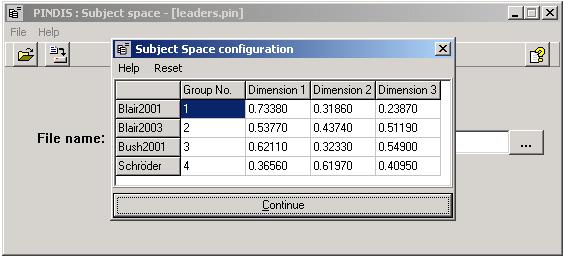
If the items in the subject space are assigned to a priori groups, SUBJSTAT provides a means of examining the differences between these groups in their weighting of the dimensions of the space. The mean direction of a set of vectors is the mean of the normalized subject weights which it contains, and is used to calculate the mean resultant for the set of vectors. Subtracting this measure from 1.0 yields an index of angular variation of a set of directed vectors, with the important property that the total angular variation can be separated into within-group and between-group components, analogous to the property of normal variance applied in analysis of variance. If the weights are all positive, however, the maximum value is dependent upon the dimensionality of the subject space. Mardia (1972) proposed a transformation of the index of angular variation to yield values in the range 0 to infinity, which is called the circular standard deviation index.
Where items are assigned to groups, SUBJSTAT
produces descriptive statistics: the resultants, standard
deviations
and mean directions (in dimension coordinates), followed
by an analysis of angular variation (ANAVA).
Unfortunately there is no ANAVA analogue of two-way or multiple-way
analysis of variance. It
is necessary to perform several separate one-way ANAVAs, assuming that
there is no interaction between them, but there is no
way to check the validity of this assumption. An F-test for
ANAVA also assumes
that angular
variation within groups is homogeneous, and the sigificance level is
accurate only when the observations (i.e. the subject weights)
are independently distributed and in the range -1.0
to +1.0, which is not
the case with these results. However, the weights entered can
be considered conditionally independent, at least when the
stimulus configuration is obtained from a hypothesized stimulus
space which has been used to compute the weights.
SUBJSTAT
then calculates the arc-distances between the end points of the
normalized subject vectors, which offers an
appropriate measure for the analysis of the distances between subjects
in the subject space. It also reports the arc distances between
individual subjects and the means for the groups to which they may have
been assigned. These can then be submitted to multidimensional scaling
by MINISSA to obtain
a graphical representation of the subjects in a Euclidean
space, if desired.
Finally, SUBJSTAT
offers to apply Mike Brusco's
non-hierarchical clustering procedure to partition
the subjects according to the
similarities in their arc-differences. This may support, or suggest
possible changes to, a priori allocations
to groups which may have been made made on inputting the data.